
Gospel (Lc 4,16-30): At that time, Jesus went to Nazareth, where he had been brought up. As was his custom, on the Sabbath day he went to the synagogue and stood up to read. They gave him the book of the prophet Isaiah. Opening the book, he found the place where it is written: «The Spirit of the Lord is upon me, because he has anointed me to proclaim good news to the poor. He has sent me to proclaim freedom for the prisoners and recovery of sight for the blind, to set the oppressed free, and to proclaim the year of the Lord’s favor.».
Then he closed the book, gave it back to the attendant and sat down. The eyes of everyone in the synagogue were fixed on him. Then he began to say to them, «Today this scripture passage that you have just heard has been fulfilled.» All spoke well of him and were amazed at the gracious words that came from his lips. «Isn’t this Joseph’s son?» they asked. Jesus said to them, «Surely you will quote this proverb to me: ‘Physician, heal yourself!’ And you will quote this proverb to me: »Do here in your hometown what we have heard that you did in Capernaum.« And he added, »Truly I tell you, no prophet is accepted in his hometown. But I tell you the truth: There were many widows in Israel in the time of Elijah, when the heavens were shut up for three years and six months and a severe famine spread over the whole land. However, the prophet Elijah was not sent to any of them, but only to a widow in Zarephath in Sidon. And in the time of the prophet Elisha, there were many lepers in Israel, but none of them were healed, except Naaman the Syrian.
When they heard these words in the synagogue, they were furious. They got up and drove him out of the town. They took him to the brow of the hill on which the town was built, intending to throw him down the cliff. But Jesus, passing through the midst of them, went on his way.
The text of Luke 4,16-30 It tells us about an important moment of Jesus. He makes his first public appearance in Nazareth, his hometown. This excerpt shows how Jesus faced rejection from the people who knew him well. We see here how faith Disbelief and composure are intricately intertwined.
Seeing how the residents of Nazareth reacted, we thought about acceptance and... faith in our lives. This article delves into these stories to better understand their lessons today.
Introduction to the Reflections on Luke 4:16-30
The beginning of Luke 4,16-30 marks a crucial point in the journey of Jesus. Show the rejection that He faced in Nazareth. More than that, it highlights the main ideas of his preaching. The story shows Jesus trying to share his vision with people from his childhood, who showed doubt and opposition.
This part of the Bible makes us think about... rejection in our lives. When we try to pass on messages of hope, we may encounter barriers. What Jesus went through reflects our own difficulties, questions, and fears. It is a time to reflect on how rejection affects our faith and our personal growth.
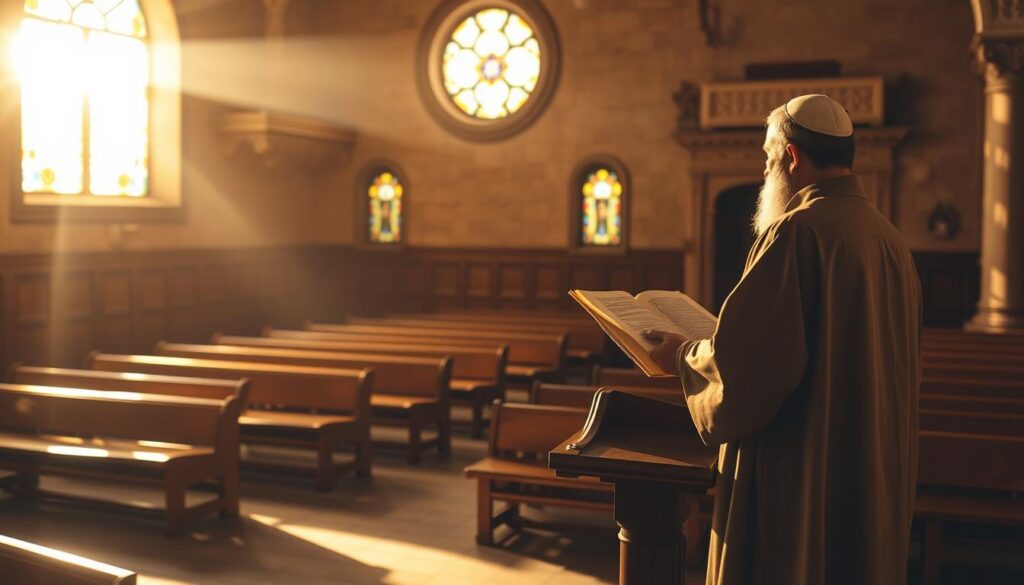
The Reading of Scripture in the Synagogue of Nazareth
Reading the scriptures in synagogue of Nazareth It was a significant moment for Jesus. He returned to his hometown and maintained the tradition of attending Sabbath meetings. The synagogue was a central point of the community. There, people gathered to discuss and understand the Scriptures.
A synagogue reading in Nazareth It wasn't just a religious practice. It strengthened the spirituality of the community.
The Context of the Synagogue
In the synagogues of Jesus' time, teaching and reflection took place. Parents taught the faith to their children. Leaders discussed the meaning of the scriptures. Those who went to the synagogue kept the traditions and teachings of the Torah alive.
Thus, with the synagogue reading in Nazareth, Jesus demonstrated his role in this learning cycle. He addressed an audience he already knew, which allowed for a deeper conversation about sacred truths.
The Opening of the Book of Isaiah
When he read, Jesus chose a passage from Isaiah. He read a passage from Isaiah on release and healing. This text highlighted the Jesus' mission.
Not only did he explain his mission, but he also marked a new understanding of his work in Jesus' context. By reading aloud, Jesus revealed who he was and what his plans were. This prepared the people for what was to come.
The Announcement of the Good News
A Jesus' mission He changed history, bringing hope to those who suffer. He fulfilled Isaiah's prophecies, focusing on the marginalized.
The Mission of Jesus according to Isaiah
Isaiah shows that Jesus came to liberate and heal. He not only preached, but changed lives. His mission was also to reconcile and give new chances.
Message Recipients
Jesus looked beyond Israel, targeting all who feel marginalized and in need of hope. This shows that his message is universal, for everyone, without exception.
Rejection of Jesus in His Homeland
Jesus' arrival in Nazareth was initially well-received. People admired what he said and taught. However, this admiration turned to doubt. The inhabitants of Nazareth began to question whether he truly had authority, as they saw him as the son of Joseph the carpenter. This shows how difficult it can sometimes be to believe in someone we know well.
Admiration that Turned into Skepticism
O skepticism in Nazareth This illustrates a common challenge in many communities. Because they had known Jesus since he was a child, people had difficulty seeing his true potential. The saying that a "physician" must "heal himself" illustrates this challenge. Villagers expected Jesus to perform miracles before fully believing in him.
The Proverb: "Physician, heal thyself"“
This saying captures the resistance of the Nazarenes. They expected Jesus to perform spectacular miracles because he was from there. But by demanding miracles before believing in him, they demonstrated distrust. This demand reveals the limitations in people's faith when they already know someone so intimately.
Luke 4:16-30: Examples of Elijah and Elisha
In Luke 4,16-30, Jesus speaks of Elias It is Elisha. It shows how great God's love and compassion are. These stories prove that God's goodness was not only for the Israelites.
The Widow of Zarephath and Naaman the Syrian
Elias helped widow of Sarepta, a non-Israelite woman. This action shows that God cares for everyone, not just the Israelites. Similarly, Elisha healed Naaman, a Syrian leper. This highlights that God loves everyone, no matter where they are from.
The Universal Message of Jesus
Jesus wanted us to understand something important. God's compassion transcends our divisions. The stories of the widow and of Naaman They teach about divine goodness for everyone. They encourage us to see faith in a new way, promoting inclusion.
The People's Furious Reaction
When Jesus spoke about His welcoming message, a reaction of the people He appeared in Nazareth. At first, everyone was amazed and could have welcomed Jesus. But that admiration turned to anger very quickly.
This change shows how difficult it was for them to accept new ideas. They were very attached to local traditions.
From Admiration to Violence
What began as a positive reception became violence in Nazareth. This happened because people's expectations were not met. When Jesus said that his message was for everyone, not just the Jews, it created an atmosphere of fear and anger.
People's beliefs were challenged. This caused strong feelings to lead to impulsive acts.
The Intention to Expel Jesus
In the midst of the chaos, the expulsion of Jesus The crowd made it a real possibility. This happened because they were afraid of what was new and different. They tried to push away someone who came to help.
Their attitude shows how difficult it was for them to accept new truths. It also demonstrated the weakness of their religious foundations.
Prayer and the Testimony of Faith
Facing rejection is hard, just as it was for Jesus in his homeland. This situation can leave us isolated. But... prayer It helps us a lot in these moments. It allows us to find strength and direction, with the Holy Spirit guiding us when we need it most.
How to Deal with Rejection in Our Lives
To deal with rejection, we need courage and to not give up. Keeping our faith strong helps us overcome obstacles. Here are some tips:
- Seeking help through prayer daily.
- Sharing experiences with other believers to find encouragement.
- Reflect on biblical passages that speak of rejection and overcoming adversity.
The Role of the Holy Spirit in Our Lives
O Holy Spirit He gives us comfort and wisdom to overcome challenges. He guides us, showing us that we are not alone. With his help, our faith grows stronger. Thus, we can face rejection and still speak of the Gospel with strength.
The Meaning of Jesus' Ministry
O ministry of Jesus It is an invitation for us to change, to have hope, and to be free. He helps us emerge from the shadows of pain and fear. Jesus' life is not just about miracles. It shows his commitment to doing good and including everyone, demonstrating what a true prophet does.
Promoting Liberation and Hope
Jesus worked to liberate people. He healed the sick, helped the excluded, and gave hope to the lost. His actions teach us that... release It goes beyond the body; it touches the soul. It invites us on a journey of faith, inner transformation, and rediscovery.
The Role of the Prophet in Society
Jesus' work shows what it means to be a prophet. He spoke hard truths and confronted injustices. His voice guides those who seek justice and want to challenge the injustices of power. Today, this example of a prophet is very important. He inspires those who wish to change the world for the better.
Conclusion
What we learn from Luke 4:16-30 is crucial for understanding our reaction to Jesus' message. It shows the rejection that Jesus suffered. And it makes us think about whether we are ready to spread his word, even when facing difficulties.
Jesus faced rejection, but he pressed on, guided by... Holy Spirit. Likewise, we are called to be steadfast in faith. Keeping hope alive and fighting for freedom are essential every day. This shows the strength of our commitment.
Reflecting on this passage from Luke, we see that faith is fundamental. Receiving the Jesus' message It should lead us to acts of love and kindness. This changes our lives and the lives of those around us, spreading hope.
FAQ
What happens in the account in Luke 4:16-30?
The text talks about the first time Jesus spoke publicly in Nazareth. He was rejected by his own neighbors. This happened even after he revealed his mission to bring release and healing.
How is reading Isaiah meaningful to Jesus?
By reading Isaiah 61:1-2, Jesus shows who He is. He reveals that He came to help those whom society ignores. This marked the beginning of His work.
Why does Jesus' message include everyone, and not just the Israelites?
Jesus had a message for everyone, not just the Israelites. He wanted to reach those who felt left out, bringing hope to all. This went against the rules of the time.
What was the reaction of the people of Nazareth when they heard Jesus?
At first, the people of Nazareth were amazed. But soon they doubted and turned against Jesus. They even tried to drive him out of the city.
How can the story of Jesus encourage us in rejection?
Knowing that Jesus also experienced rejection helps us move forward. It inspires us to continue sharing God's love, even when we encounter resistance.
What is the role of prayer in times of rejection?
Prayer gives us strength and guidance when we feel rejected. It's a way to let the Holy Spirit guide and comfort us during these difficult times.
How does Jesus' ministry reflect social and spiritual issues?
Jesus fought for social change. He healed people and challenged the powerful who imprisoned the weak. His work is an invitation for us to fight for justice and hope.
Content created with Artificial Intelligence Assistance